 Taiwan was the top item on the agenda during President Donald Trump's summit with Chairman Xi Jinping. While nothing was discussed of particular significance, all signs show that Trump has softened his support for the island China contend's is theirs. I asked Google about Trump's current attitude on this subject:
Details of the situation include:
- Arms Sales as Leverage: Trump recently delayed approving a $14 billion U.S. arms sale package for Taiwan. In an interview following his summit with Chinese President Xi Jinping in Beijing, Trump stated: "I'm holding that in abeyance and it depends on China... It's a very good negotiating chip for us, frankly."
- No Official "Grand Bargain": Following the Beijing meetings, Trump told reporters he "made no commitments either way" regarding Taiwan and stressed that U.S. policy fundamentally remains unchanged. Chinese officials reportedly pushed heavily during the summit to scale back U.S. arms supplies and rhetorical support for Taiwan, though no formal concessions were publicly announced.

- Opposition to Independence: Trump has cautioned Taipei against formally declaring independence. In a television interview, he said, "I'm not looking to have somebody go independent... and we're supposed to travel 9,500 miles to fight a war. I'm not looking for that."

- Taiwan's Response: Taiwan's leadership maintains that it is already a sovereign democracy and has urged Washington to fulfill its security commitments as outlined in the Taiwan Relations Act, which binds the U.S. to providing Taiwan with the means to defend itself. [1, 2, 3, 4, 5, 6, 7, 8, 9, 10]


No, President Donald Trump cannot simply "give" Taiwan to China, as Taiwan is a self-governing democracy and not a U.S. territory to hand over. However, as president, he holds immense influence over U.S. foreign policy and security guarantees, which could drastically alter Taiwan's geopolitical safety and independence.[1, 2, 3, 4]

- The Taiwan Relations Act (TRA): This U.S. law, passed by Congress in 1979, requires the United States to provide Taiwan with the means to defend itself. Any action to formally abandon this commitment would require cooperation and new legislation from Congress.
- Bipartisan Congressional Opposition: Taiwan has strong, deeply entrenched bipartisan support in the U.S. Congress. Lawmakers across both parties overwhelmingly support maintaining Taiwan's democracy and oppose aggressive Chinese expansion.

- Taiwan's Sovereignty: Taiwan operates as a fully independent, sovereign democratic state with its own constitution, military, and government. It is ultimately up to the people and government of Taiwan to determine their own political future. [1, 2, 3, 4, 5]


While the President cannot hand Taiwan over directly, the executive branch has broad authority over foreign relations and defense. President Trump's specific policy decisions could significantly impact Taiwan's security:
- Arms Sales and Leverage: The president must sign off on foreign military sales. For instance, following meetings with Chinese President Xi Jinping in Beijing, President Trump has treated a multibillion-dollar arms package for Taiwan as a "negotiating chip" to secure other concessions from China.

- Security Assurances: The President plays a major role in interpreting U.S. defense policy. A stated reluctance to defend Taiwan in the event of an attack or a move by the U.S. to formally recognize Chinese territorial claims could significantly embolden Beijing to take hostile action. [1, 2, 3, 4, 5]


This is no way to end a posting on Saturday, so let me finish with something positive, like the Northern Lights.
- These are luminous glows seen around the magnetic North and South Poles. Ribbons of colorful lights.
- Auroras are a result of the sun interacting with the Earth's atmosphere. A collision between electrically charged particles from the sun, and gases in the Earth's atmosphere, produces minuscule flashes that look like moving lights in the sky. These charged particles are pulled in the direction of the North and South Poles.
 The prime Aurora Borealis viewing season is long, from late August to early April, with peaks in March and September. Highest probability generally between 10PM and 2AM.

 Here is a video filmed over Iceland filmed on 20January2026 from a G4 magnetic storm.

 Best when there are solar storms and coronal mass injections, and info can be obtained from the NOAA Space Weather Prediction Center and Canadian Space Agency AuroMax platform.
- Having been in Canada these past few weeks, I know that sightings of the Aurora Borealis are not a particularly big deal. Even in southern Canada, you can generally expect to see them as many as one to three times/month, usually during episodes of high geomagnetic activity and the right solar cycle phase.
 Turns out that further north around the 60th parallel (in places like Yellowknife and Churchill), they see auroras almost every night.
- Cities like Montreal, Toronto and Vancouver experience them only a few nights a month, but you want to travel outside the the city to avoid light pollution.


 And, of course Alaska is positioned to see auroras dozens of time a year.
- I bring this subject up today because chances are good that a geomagnetic storm will reach G1 (mild) status tonight, so Northern Lights may be viewable this weekend in these states: Alaska, North Dakota, South Dakota, Minnesota, Wisconsin, Michigan, Maine, Montana, Idaho and Washington.

 If the geomagnetic storm hits G2 level (moderate), the lights might be seen even further south, adding New York, Illinois, Iowa, Wisconsin and Oregon.
- Current forecasts show it is unlikely for attaining G3 (strong) level. But if reached, auroras could be seen as far south as Pennsylvania, Ohio, Indiana, Nebraska, Wyoming and California.
- This began Friday night and will occur again tonight.

- There could be a spike around 8PM ET. The 11PM and 2AM timeframe also looks promising.

- Find a dark north-facing spot away from light pollution.


Amazingly enough, the Aurora Borealis has been observed at least twice in Hawaii.
- Recently, on May 11, 2024, the northern lights were faintly seen across the Hawaiian Islands. Here is a video of this sighting. This photo was taken in Naalehu. I once lived there.
- The only previous time was during the Carrington Event in 1859 when Hawaii reported a "fire in the sky."
- That's it!
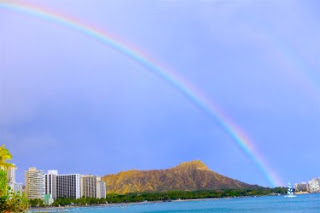
Final photo to close, the view from where I sit composing this posting.

-
Comments
Post a Comment