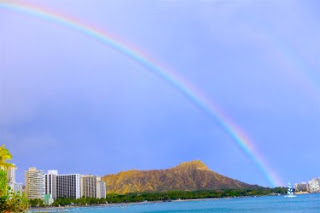
Kiko remains a hurricane, but should by tomorrow weaken into a tropical storm. If the eye went over Hawaii, there would still be some devastation and a lot of flooding. However, the track has been predicted to pass sufficiently north of the state such that high surf and associated damage might well be the only problem.


The Atlantic Ocean and Gulf of America are eerily quiet as high season begins. No serious ocean storms are predicted for at least the next week.
In the East Pacific is Post-Tropical Cyclone Lorene so inconsequential that it is not even shown on the map.


Almost all ocean storms in the East Pacific threaten Mexico, especially the Baha Peninsula, but only very rarely extend into California. Why doesn't California suffer from hurricanes?
- For one, San Diego is at 32.72 North latitude, while Honolulu is at 21.31.
- Thus, Hawaii is north of San Diego and the rest of California.
- Ocean waters get colder from the equator up and down to the North and South Poles.


- The population of the city was only 4300, but newspaper accounts mentioned that a Category 1 hurricane made landfall.
- “A terrific gale sprung up from the S.S.E. [south-southeast],” reported the Daily Alta California at the time, “and continued with perfect fury until about 5 p.m., when it somewhat abated…It blew with such violence, and the air was filled with such dense clouds of dust, that it was impossible to see across the Plaza…[H]ouses were unroofed and blown down, trees uprooted, and fences destroyed. It is said to have been the severest gale ever witnessed in San Diego.

- A tropical storm made landfall over Long Beach in 1939.

- There was no name, for storms began to be identified by the U.S. National Weather Service only from 1953, all female.
- Males names were introduced in 1979.
- Actually, the history of names is muddied, for there was a hurricane Santa Ana in 1825, San Felipe in 1876 and San Felipe again in 1928, all damaging Puerto Rico.


- Officially, the Joint Army/Navy Phonetic Alphabet began to be used in 1947, when Hurricane George was so-named on 5September1947, reaching Category 4 status at 145 MPH on September 15 near the Bahamas, and barrelled into Fort Lauderdale, Florida on September 17 at 150 MPH, with speeds as high as 180 MPH in other nearby coastal areas. Killed 17.

- Once at Category 4, Hurricane Hilary in 2023 almost made it to California, but not quite. Yet, gusts up to 87 MPH were received in Los Angeles, and it rained 2.20 inches at Furnace Creek in Death Valley, which was more than its annual rainfall of 2.15 inches. Watch this video.


But those were rare exceptions. Why don't hurricanes hit California?
- The average Atlantic hurricane season runs from June 1 to November 30, sees 14 named storms, including seven hurricanes and three major hurricanes (Category 3 and higher). Hurricanes make landfall over New York City, which is at 40.7 N latitude, much further north than San Diego at 32.7 or San Francisco at 37.7.
 The East Pacific basin hurricane season runs from May 15 to November 30, with 15 named storms, eight hurricanes and four major hurricanes.

 But the Pacific Ocean holds 50.1% of all the ocean waters, more than twice as much as the Atlantic, at 23.3%.
- There is only a rare hurricane that forms south of the equator in the Atlantic Ocean.
- A good part of the Pacific Ocean is warmer.
- In the Atlantic, the gulf stream provides a steady infusion of warm water along the Eastern Seaboard. Plus the Atlantic Basin is 2.5F warmer than the east Pacific.

 Importantly, cold waters from the northern coastal area flow south, keeping California ocean temperatures relatively cool. I remember, for example, when living in Oxnard, California during the summer: Oxnard is 60 miles north of Los Angeles, but these currents keep Oxnard cool, say at 70F, when Los Angeles can be more than 100F. Amazingly enough, Santa Paul, 20 miles inland of Oxnard, can be up to 115F.

 Winds play a role too.
- These winds steer hurricanes in a east to west direction, as you noticed in Atlantic from Africa towards the USA, and in the Pacific from Mexico to Hawaii.

 Also, in the Pacific, there are high altitude winds from west to east that cause turbulence, a shearing effect that inhibits and/or weakens tropical cyclone formation.

 Not only is California protected, but so is Hawaii.
- With all those Category 4 and 5 hurricanes heading to the state of Hawaii the Big Island of Hawaii, in recorded history, has NEVER experienced even one hurricane. Ocean storms make landfall over the island, but only as a tropical storm.
 The Pacific Ocean has been aided by more frequent La Ninã cycles, keeping ocean waters cooler than usual.
- Unfortunately, this is expected to change with global warming.
- A new study from NPJ Climate and Atmospheric science predicts that the Eastern Pacific will have 33% more ocean storms in the coming years.


 That's bad for Hawaii and Mexico, but perhaps also in the future for California.
- Worse, over the next decade, the number of Atlantic hurricanes and tropical storms could DOUBLE, compared to the 1970s.
- This is ironic, but air pollution laws now mean that particulate matter absorbing or blocking sunlight, is diminishing, so the oceans will get warmer.
- Finally, global warming means ocean warming, and this will lead to more frequent and intense hurricanes.


-
Comments
Post a Comment