 The geekiest fashion trend inspired by political reporting has to be that of Steve Kornacki of MSNBC.
- He is the affable big board star on TV, and is known for his glasses and khakis.
- His election projections and returns are priceless.
 As you know, Kornacki has now branched out into events like the Kentucky Derby and major sporting events.
- Khakis are not only casual, but now also cool.

 Gap had a 1993-5 Who Wore Khakis ad campaign, and trotted out Miles Davis, Sammy Davis Jr., Andy Warhol, Ernest Hemingway, Arthur Miller and Amelia Earhart. Guess who was the model to the right? Initials AW.
- Kornacki mostly wears trousers by Gap.
- Looking closely at Kornacki's trousers, they are not the traditional brownish-tan khaki. Costs $60 and features a stretch waistband and stain-resistant weave.

 Dockers, owned by Levi, competes with Gap on this piece of wear.
- Go to Amazon and see a whole bunch of khaki trousers from $18 to $98, which is a Huckberry Flint and Tinder Men's 365 Pant, Stretch Comfort, 5-pocket version.

History of khaki.
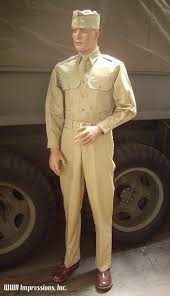
- The British first began wearing khaki during their occupation of India. This tan-colored camouflage became popular throughout the world. What is khaki?
- It is a color....light shade of tan, with a slight yellowish tinge.
- The term is borrowed from the Persian Urdu, for khak is dust.
 First attributed to Sir Harry Lumsden, Brigadier Gemeral founder of the Corps of Guides in India, and worn by Indian soldiers in 1946 for the British East India Company, for the cotton pajamas were not ideal for the sweltering summers, and this new material was breathable. The original khaki fabric was a closely twilled cloth of linen or cotton, dyed in mud.

 Two years later utilized in British military uniform in India, for the color served as camouflage in a desert battle British forces became known as Khakis.
- The U.S. followed by adopting khaki during the Spanish American War of 1898. Added in 1902 a brown-green uniform named olive drab, called khaki green or olive green.

 Famous people like Teddy Roosevelt, Charles Lindberg and Ernest Hemingway commonly wore khaki. Katherine Hepburn resented the Hollywood standard of dresses and skirts, and owned hundreds of pairs of khaki slacks.

 Following World War II, khaki-colored chino cloth twill trousers became a common part of civilian clothing.
- In the 1950's and '60's, Casual Fridays appeared, with Hewlett-Packard being the pioneer. Khaki was a relaxation from the formal, and the concept of smart casual came into play.

 Historian Jan Tynan and author of The British Army Uniform and the First World War: Men in Khaki said:

There's this idea that the khaki pants, the military boots, these bomber jackets, the camouflage pants, and the whole gear represents this idea of freedom and power. It becomes an aspiration, really, for the general public to see the military as cool, fashionable, something that they want to look like. Whenever it comes back on the floor, and it's being sold as fashionable again, it's because there is a geopolitical agenda often that is at play.
 Hawaii companies adopted aloha attire from 1962, promoted by the Hawaiian Fashion Guild, and Aloha Friday officially began in 1966 when Bank of Hawaii president Wilson Cannon (who grew up on Maui) began to wear an aloha shirt to work, with the staff also doing so on Fridays. Kimo Kahoano and Paul Natto have a song, Aloha Friday. Now, it's Aloha Everyday.

Shades of brown can be produced by combining red, yellow and black, or orange and black.

Pretty clear which square is the standard khaki, as shown to the right. However, the RGB color model that generates colors for television and electronics uses on red, green and blue. Brown is made by combining red and green.
I hate khaki. Why? When I was in the U.S. Army, we had to wear starched khaki, next to hair shirt as the most uncomfortable clothing created by man. Also expensive, for they were dry cleaned too, and this had to done at least weekly. We were allowed to wear olive drab fatigues most of the time. Not terrifically comfortable compared to the fabrics today, but at least not starched.
But the Army got smart in 2005 (ACU stands for Army Combat Uniform):

All Army Activities Message Date Time Group 2022002 April 2005, announced the instructions on the wear and care of the wrinkle-free, universal camouflage pattern ACU ensemble. In these instructions it clearly states Soldiers will not starch the ACU under any circumstances. The use of starch, sizing and any process that involves dry-cleaning or a steam press will adversely affect the treatments and durability of the uniform. It is designed to be ready to wear. Removing the uniform immediately from the dryer and laying it flat or hanging it up may help reduce wrinkling.
 For those who want to join the trend, Palomino brown is the latest popular khaki.
- Kornacki represents intelligence, mild dishevelment, and intense concern. No sport coat, off course, but a tie.
- He might have spurred Taylor Swift and Rihanna.

Oh, oh, a potential tropical cyclone is close to forming in the Caribbean Sea. Projected to slip between the Yucatan and Cuba, Hurricane Helene will then trace about the same path as Hurricane Debby took last month.

-
Comments
Post a Comment